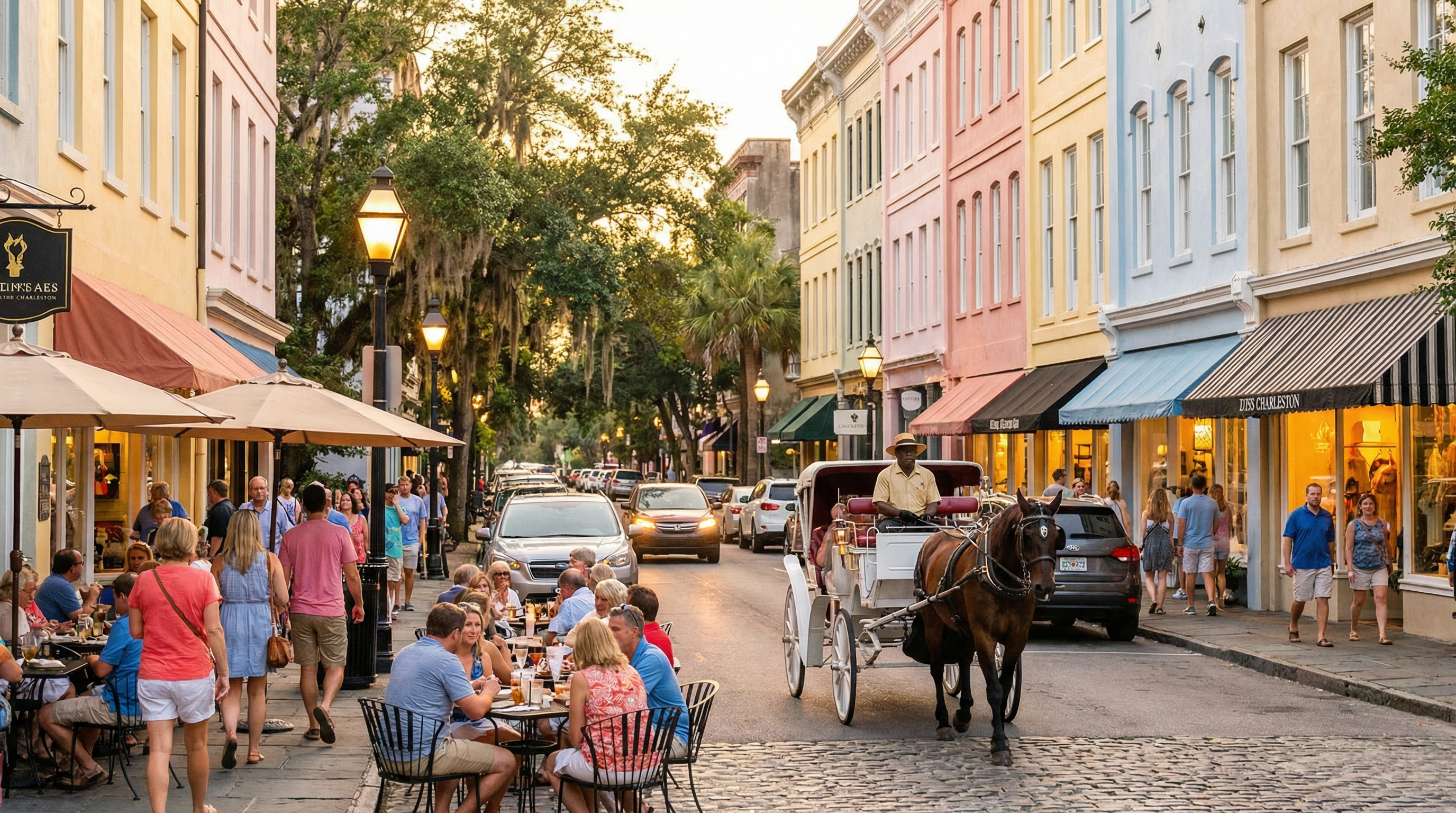
Nearly $14 billion in economic impact. Roughly 7.89 million visitors to the Charleston region. Those numbers make Charleston one of the most visited small cities in America, and they drive a question I hear almost weekly from out-of-state buyers: "Should I buy a second home in Charleston and rent it when I'm not there?" The honest answer -- the one that serves your interests rather than my transaction count -- is more nuanced than most agents will give you.
The Tourism-to-Real-Estate Pipeline
Tourism drives Charleston's second-home and vacation rental market in two distinct ways, and conflating them is the most common mistake investors make.
The first is direct: visitors want to stay in vacation rentals, which creates income potential for property owners. This is the straightforward short-term rental model -- buy a home, furnish it, list it on platforms, and generate revenue from the tourism stream.
The second is indirect but more powerful: visitors fall in love with Charleston and become residents. This is what I call the "tourism tail" effect. Charleston's net migration has been tourism-fueled for over a decade. People visit, they experience the lifestyle, and a meaningful percentage of them eventually relocate. That relocation demand -- driven by lifestyle, not investment returns -- is what sustains property values across the region.
Buy for the lifestyle first, rental income second. The properties that hold value best in Charleston are the ones you'd want to live in yourself. If the rental income disappears tomorrow -- because of regulation, because of a hurricane season, because the market shifts -- you still have a home you love in a place you chose deliberately. That's the investment thesis that survives volatility.
Not All Neighborhoods Benefit Equally
This is where the conversation gets specific, and specific is where value lives.
Isle of Palms: High Visibility, High Yield, High Regulation
Isle of Palms has the highest tourism visibility of any Charleston-area neighborhood. The beach, the resort at Wild Dunes, the proximity to downtown -- it all creates strong rental demand. But Isle of Palms also has the most active regulatory environment for short-term rentals. The town has implemented and continues to refine rules around rental permits, density, and noise that directly affect investor returns. For a full breakdown, read my post on Isle of Palms short-term rental rules.
Sullivan's Island, adjacent to Isle of Palms, has even stricter limitations. If pure rental income is your primary motivation, understand the regulatory landscape before you make an offer -- not after.
Downtown Charleston: Strong Demand, Strict City Rules
Downtown Charleston supports a robust short-term rental market driven by tourism demand, but the City of Charleston regulates short-term rentals through a permitting system that limits where and how you can operate. Zoning districts, owner-occupancy requirements, and permit caps all affect whether a specific downtown property can legally function as a short-term rental. This isn't speculation about future regulation -- these rules are in effect now.
Daniel Island: A Different Kind of Second-Home Market
Daniel Island has relatively low tourism impact compared to the beaches and downtown. Visitors don't come to Daniel Island for vacation -- they come for events like the Charleston Open or club golf. But Daniel Island has a significant second-home market driven by corporate executives and lifestyle buyers who maintain a Charleston residence alongside a primary home elsewhere. This is relocation-driven second-home demand, not tourism-driven, and it behaves very differently: less seasonal volatility, longer hold periods, and less sensitivity to short-term rental regulation.
Isle of Palms Market Dynamics
The Isle of Palms market report covers current pricing in detail, but the key insight for second-home buyers is this: the properties that perform best as investments are the ones that work both as rentals and as personal-use homes. A three-bedroom oceanfront condo that you use for six weeks a year and rent for twenty generates income while also giving you a home base in a place you love. A property purchased purely for rental yield, with no personal connection to the location, is a spreadsheet exercise that's vulnerable to every regulatory change and market shift.
The Tourism Tail: Visitors Become Residents
The data on this is compelling. Charleston has been one of the fastest-growing metro areas in the Southeast for over a decade, and the migration pipeline is heavily influenced by tourism exposure. People visit Charleston -- for a wedding, a conference, a vacation, a festival -- and they begin a relationship with the city that eventually leads to relocation.
| Tourism Channel | Typical Buyer Profile | Relocation Timeline | Target Neighborhoods |
|---|---|---|---|
| Beach vacations | Families, retirees | 2-5 years | Isle of Palms, Mount Pleasant |
| Historic district tourism | Culturally motivated professionals | 1-3 years | Downtown, Old Village |
| Events (Spoleto, SEWE) | Affluent, arts-oriented | 1-3 years | Downtown, Daniel Island |
| Corporate visits/conferences | Executives, entrepreneurs | 6-18 months | Daniel Island, Mount Pleasant |
| Weddings and social events | Young professionals, couples | 3-7 years | Varies widely |
This pipeline is why Charleston's housing market has been remarkably resilient through cycles that hit other tourism-dependent markets harder. The demand isn't purely tourism-driven -- it's lifestyle-driven, with tourism as the introduction. That distinction matters enormously for long-term property values.
The Risks of Tourism-Dependent Properties
I'd be doing you a disservice if I didn't address the risks directly. Properties purchased as pure short-term rental investments in Charleston face three structural vulnerabilities:
- Regulatory risk: Short-term rental rules are tightening across the region, not loosening. Municipal governments are responding to residential complaints, and the trend toward more restrictive permitting is clear.
- Hurricane disruption: A significant hurricane season can eliminate months of rental income and create insurance complications that affect cash flow for a year or more. Coastal properties in Isle of Palms and Sullivan's Island carry this risk inherently.
- Seasonal volatility: Charleston tourism peaks from March through October. November through February is materially slower, and properties that need year-round rental income to cash-flow may underperform during the off-season.
For a deeper understanding of how tax strategy intersects with investment properties, my post on 1031 exchanges in Charleston covers the mechanics.
The Right Way to Think About a Charleston Second Home
Start with the lifestyle question: do you want to spend time in Charleston? If the answer is yes, buying a second home here is a decision that can generate both personal value and financial returns. If the answer is "I'm looking for the best rental yield," I'd encourage a broader conversation about where that yield actually exists and whether Charleston's regulatory and weather environment supports the returns you need.
The strongest second-home purchases I've facilitated are the ones where the buyer loves the place, uses the property personally for several weeks a year, and treats rental income as supplemental rather than essential. Those buyers are never disappointed, because the investment thesis doesn't depend on occupancy rates or platform algorithms. It depends on Charleston being the place they want to be -- and that's a bet I'm comfortable making.
If you're exploring a second home or investment property in the Charleston region, let's talk. I'll give you the honest assessment -- the neighborhoods that work, the regulations that matter, and the properties worth your attention on the current market.