Pull up Park Circle on Zillow and you will see home prices, square footage, lot sizes, and estimated monthly payments. What you will not see is the story behind the numbers -- the decade of public investment, community organizing, and incremental transformation that turned an overlooked pocket of North Charleston into one of the most desired walkable neighborhoods in the Charleston metro. That story is what actually drives the values, and it is the part that matters most if you are deciding whether to buy here.
Where Park Circle Was: The Starting Point Most People Forget
Ten years ago, Park Circle was a neighborhood with good bones and not much else. The street grid was walkable -- laid out in the 1910s and 1920s with a classic neighborhood design centered on an actual circular park. The houses were solid -- 1940s to 1960s Craftsman bungalows and cottages with hardwood floors, plaster walls, and the kind of proportions that modern tract homes cannot replicate. And the prices were accessible -- well below $200,000 for most homes.
But the commercial life was thin. A few restaurants, limited retail, no brewery scene, no farmers market, no reason to drive across the highway if you did not already live there. The park itself was functional but uninspired. And the neighborhood's location in North Charleston -- not the City of Charleston, not Mount Pleasant -- carried a perception gap that suppressed values relative to the actual quality of the housing stock.
The Public Investment That Changed Everything
What transformed Park Circle was not a single developer building a flashy project. It was a sustained, multi-year campaign of public investment by the City of North Charleston that changed the infrastructure, the public spaces, and -- critically -- the signal that the government was committed to this neighborhood's future.
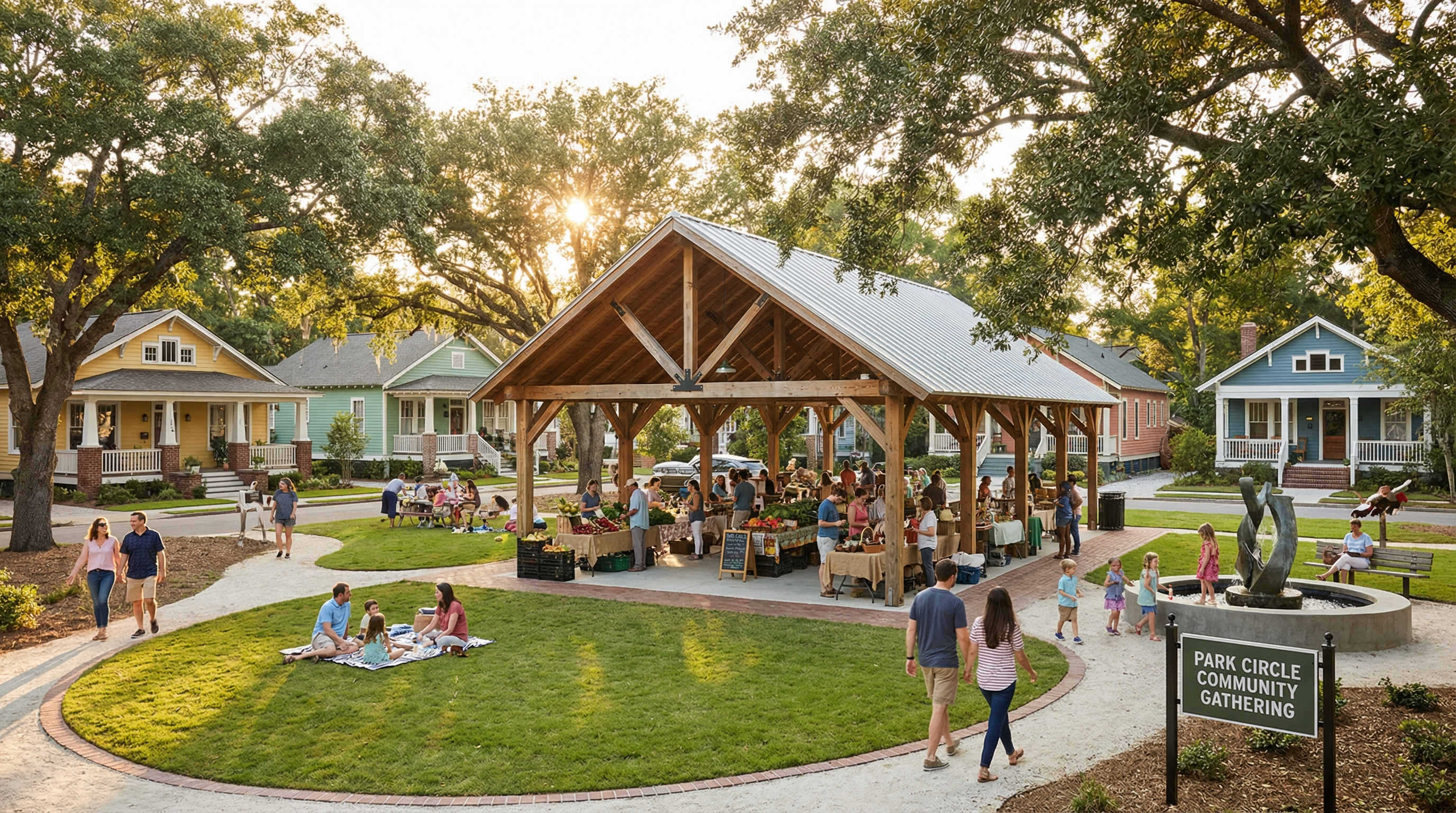
The "Park Circle Reimagined" project is the most visible example. The city redesigned the inner circle of the park itself with an inclusive playground accessible to children of all abilities, a community building with event space and arts programming, and a farmers market pavilion that hosts a weekly market drawing vendors and visitors from across the region.
But the park redesign was just the centerpiece. The broader investment included:
- Streetscape improvements -- new sidewalks, street trees, crosswalks, and traffic calming that made the grid safer and more pleasant to walk
- Drainage and infrastructure upgrades -- addressing the flooding issues that plagued the neighborhood during heavy rain events
- Art installations and public space programming -- murals, sculptures, and event programming that gave the neighborhood a visible cultural identity
- Zoning and permitting support -- the city made it easier for small businesses -- restaurants, shops, studios -- to open in the commercial spaces along East Montague Avenue
The smartest buyers I work with evaluate a neighborhood not by what it has today, but by the trajectory of public investment. Park Circle's trajectory is as strong as any neighborhood in the Charleston metro. The public amenities they have built in the last five years would be the envy of communities charging twice as much per square foot.
The Restaurant and Brewery Scene: Walkable From Your Front Door
The commercial transformation along East Montague Avenue and the surrounding blocks is what most people notice first when they visit Park Circle today. The restaurant and brewery density here rivals -- and in some ways exceeds -- what you find on Upper King Street downtown, but without the parking headaches and tourist crowds.
- Madra Rua -- the Irish pub that has been an anchor for years, a neighborhood gathering spot that predates the transformation
- EVO Bakery -- wood-fired pizza and artisan bread that draws people from across the metro
- The Warehouse -- a converted industrial space that hosts events, art shows, and live music
- Monkey Wrench -- cocktails and a vibe that would be at home in any major city's walkable district
- DIG in the Park -- Southern cooking, outdoor seating, and the kind of place where you end up staying longer than you planned
What makes this scene different from, say, a suburban restaurant cluster along a highway: you can walk to all of it. From most homes in the Park Circle grid, these restaurants are a 5-to-10-minute walk. No designated driver. No parking search. You walk out your front door, down the sidewalk, and you are there. That walkability is what creates the premium.
Home Types in Park Circle: Bungalows, Cottages, and New Infill
The housing stock in Park Circle falls into three categories:
Original bungalows and cottages (1940s-1960s): These are the heart of the neighborhood -- 900 to 1,400 square feet, typically 2-3 bedrooms, hardwood floors, smaller lots. Some are original condition, some have been renovated to varying degrees of quality. A well-renovated original cottage on a good block is the most sought-after product in Park Circle.
Renovated and expanded originals: Many homes have been expanded -- additions, dormer conversions, kitchen and bath renovations. The quality varies significantly. I always recommend a thorough inspection on any renovation, because some were done by owner-occupants with permits and licensed contractors, and some were done by flippers cutting corners. The difference matters.
New infill construction: Vacant lots and tear-down properties have been replaced with new builds -- typically 1,600 to 2,200 square feet, modern floor plans, and price points at the top of the Park Circle market. These homes bring buyers who want the neighborhood but want new construction quality. The trade-off is that the new builds often feel architecturally different from the original character of the street.
Park Circle vs Downtown Charleston: The Real Comparison
Buyers who are drawn to Park Circle's walkability are often comparing it to downtown Charleston. Here is the honest comparison:
| Factor | Park Circle | Downtown Charleston |
|---|---|---|
| Walkability to dining/retail | Strong (5-10 min walk) | Strong (varies by location) |
| Price per square foot | 40-50% less | Premium pricing |
| Municipality | North Charleston | City of Charleston |
| Property tax rate | Higher millage rate | Lower millage rate |
| Tourism impact | Minimal | Significant (parking, crowds) |
| Lot sizes | Larger on average | Smaller, often zero-lot-line |
| Historical preservation rules | Minimal | Strict BAR oversight |
The municipality difference matters more than most buyers realize. North Charleston has a different tax structure, different services, different governance. That is not a negative -- it is a factor to understand. The higher millage rate in North Charleston is partially offset by lower assessed values, but the net property tax bill is something I walk through with every buyer on a property-by-property basis.
The Boeing Factor
Park Circle sits roughly 10 minutes from Boeing's North Charleston campus, which employs thousands. For Boeing engineers, managers, and technicians who want walkability and do not want to commute from Mount Pleasant or downtown, Park Circle is the obvious choice. The Boeing expansion's effect on Charleston housing is concentrated in a few neighborhoods, and Park Circle absorbs a disproportionate share of that demand because it offers something the suburbs cannot: a walkable daily life.
Why the Public Investment Story Matters for Buyers
Here is why I wrote this post instead of just giving you a market report with numbers. The numbers tell you what has happened. The public investment story tells you why it happened and whether it is likely to continue.
Public investment reduces long-term risk. When a city invests in infrastructure, public spaces, and commercial support in a neighborhood, it is signaling commitment. That commitment attracts private investment -- restaurants, shops, developers -- which attracts residents, which attracts more investment. It is a virtuous cycle, and Park Circle is in the middle of it.
The "Park Circle Reimagined" project is not the end of the public investment. It is the most recent chapter. The farmers market pavilion, the community building, the inclusive playground -- these are assets that will continue drawing people to the neighborhood and supporting the commercial ecosystem that makes Park Circle work.
If you are evaluating Park Circle, do not just look at the listing. Walk the new public amenities. Eat at the restaurants. Talk to the people sitting in the park on a Saturday morning. The energy of this neighborhood is its most valuable asset, and it is the one thing that Zillow cannot quantify. When you are ready to talk specifics, search Park Circle listings or reach out directly.