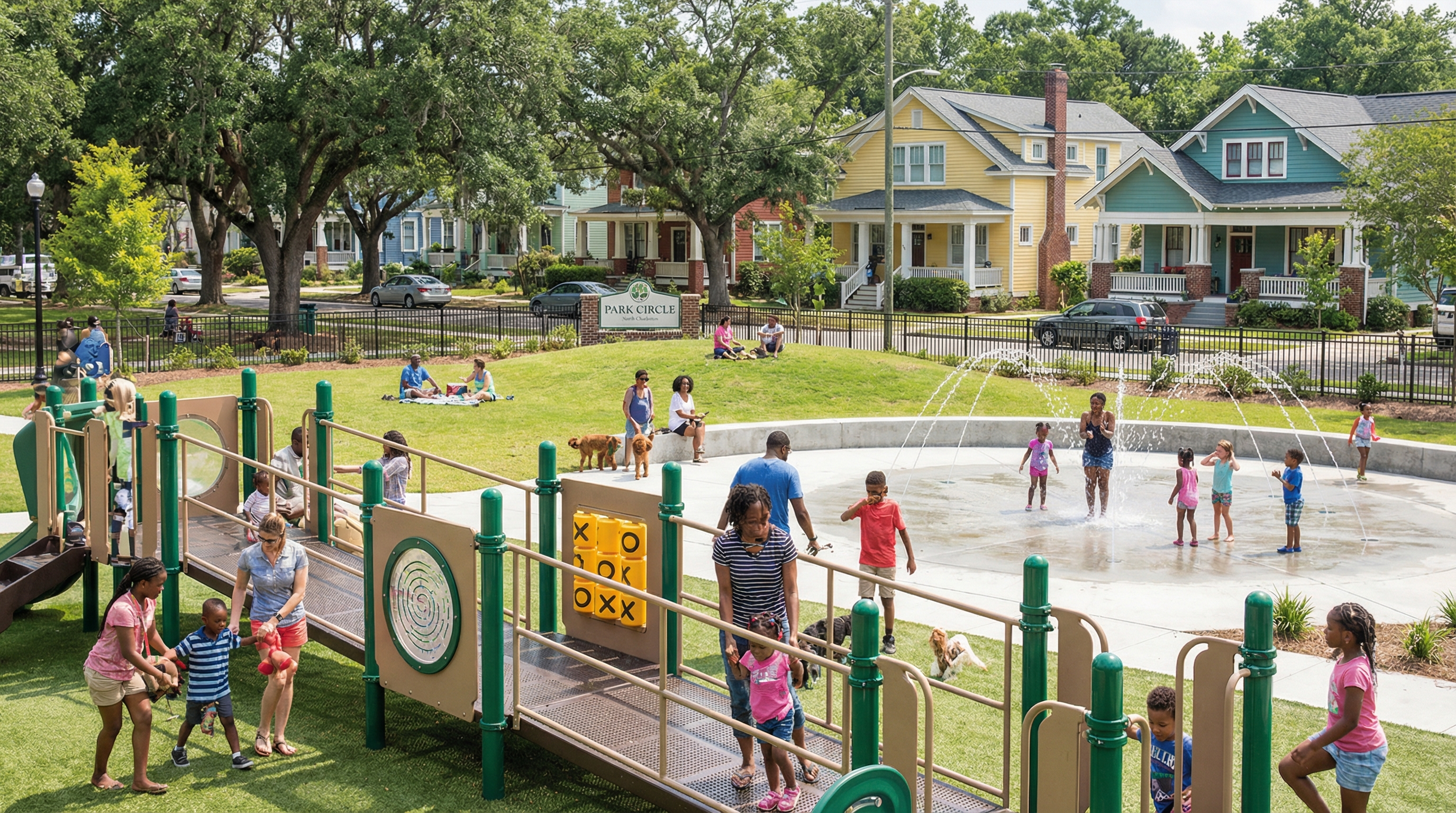
There is a concept in urban planning called the "third place" -- a space that is neither home (your first place) nor work (your second place) but somewhere you go to be part of your community. A park bench where you read the paper. A farmers market where you buy tomatoes from the same vendor every Saturday. A coffee shop where the barista knows your order. These are the places that turn a collection of houses into a neighborhood, and Park Circle has been building them deliberately and well.
Park Circle Reimagined: The New Public Infrastructure
The "Park Circle Reimagined" project, led by the City of North Charleston, redesigned the heart of the neighborhood with a focus on creating exactly these kinds of spaces. The investment was significant, and the results are tangible:
The redesigned park: The inner circle has been transformed from a basic open green into a thoughtfully designed public space with native plantings, shade structures, pathways, and seating areas that invite lingering. This is not a park you pass through on your way somewhere else. It is a destination.
The inclusive playground: Designed to be accessible to children of all abilities, the playground includes adaptive equipment, sensory elements, and surfaces that accommodate wheelchairs and mobility devices. This is not a token gesture -- it is one of the better-designed inclusive playgrounds in the state, and it draws families from well beyond the Park Circle neighborhood.
The community building: A multi-purpose facility with event space, art exhibition areas, and meeting rooms. This is the neighborhood's living room -- the place where community groups meet, art shows open, and neighborhood events are planned and hosted. Having a dedicated public building for community use is rare in residential neighborhoods, and it is one of the things that makes Park Circle feel different from other Charleston-area neighborhoods.
The farmers market pavilion: A permanent covered structure designed specifically to host the weekly farmers market. Rain or shine, the market happens. The permanence of the structure sends a message: this is not a temporary pop-up. This is infrastructure. The market has become one of the social anchors of the neighborhood, drawing vendors, musicians, and visitors every week.
Splash pad: A water play area for children that operates during warmer months. For families with young kids, this is a daily-use amenity that requires no membership, no fee, and no planning. You walk over, the kids play, you walk home.
The smartest buyers I work with evaluate a neighborhood not by what it has today, but by the trajectory of public investment. Park Circle's trajectory is as strong as any neighborhood in the Charleston metro. The public amenities they have built in the last five years would be the envy of communities charging twice as much per square foot.
The Events Calendar: What Happens in Park Circle Week to Week
Infrastructure is only as valuable as how it gets used, and Park Circle's public spaces are among the most actively programmed in the Charleston area:
- Weekly farmers market -- local produce, baked goods, artisan products, and prepared food. This is a serious market, not a handful of tables on a sidewalk.
- Food truck roundups -- rotating food trucks gather in and around the park on designated evenings, creating an informal outdoor dining event
- Live music in the park -- free concerts and performances that bring the neighborhood together on warm evenings
- Art walks -- monthly or seasonal events where galleries, studios, and pop-up exhibitions open their doors along East Montague Avenue and surrounding streets
- Olde North Charleston Festival -- the annual community celebration that fills the park and surrounding blocks with vendors, performances, food, and the kind of neighborhood pride that is hard to manufacture
The density of events matters because it creates foot traffic, which supports the restaurants and shops, which creates jobs, which attracts more residents, which supports more events. This is the virtuous cycle that transforms a neighborhood, and Park Circle's event calendar is evidence that the cycle is running.
The Research Behind the Premium: Why Third Places Increase Home Values
This is not just a feel-good story about parks and farmers markets. There is a measurable economic impact. National research consistently shows that homes within walking distance of quality public amenities -- parks, community centers, markets, plazas -- command premiums of 10 to 20 percent over comparable homes without that proximity.
The mechanism is demand. Buyers will pay more for a daily life that includes walkable access to community spaces. They are not buying square footage alone -- they are buying the experience of walking to the farmers market on Saturday, letting their kids play at the splash pad after school, attending a free concert in the park on a Thursday evening. That experience has economic value, and the market prices it in.
Park Circle demonstrates this locally. Homes within the walkable core -- roughly within a 10-minute walk of the park and East Montague Avenue -- trade at meaningful premiums over homes on the periphery of the neighborhood that share the same zip code but not the same walkability. The closer you are to the third places, the more you pay. And the more the third places improve, the more the premium grows.
The Community Building as Neighborhood Living Room
I want to spend a moment on the community building specifically, because it is the kind of amenity that most neighborhoods do not have and most buyers do not think to look for until they experience it.
The community building is available for events, art shows, meetings, classes, and gatherings. It is a public building in the truest sense -- maintained by the city, accessible to residents, and programmed with the neighborhood's input. When a community group needs a meeting space, it is there. When an artist needs a gallery wall, it is there. When a neighbor wants to host a birthday party in a space larger than their living room, it is there.
This kind of shared infrastructure reduces the isolation that can come with homeownership, particularly for people who are new to an area. It gives you a place to go, people to meet, and a reason to leave the house that does not involve a car or a credit card. For buyers relocating to Charleston who do not yet have a social network, the community building and the events it hosts are how you build one.
What This Means for Buyers Evaluating Park Circle
When I walk buyers through Park Circle, I always end the tour at the park itself. Not because the park is the prettiest thing to look at -- though it is genuinely well done -- but because the park is the proof of concept. It tells you that this neighborhood has the public infrastructure, the community energy, and the municipal support to sustain and grow its quality of life over time.
You are not just buying a house in Park Circle. You are buying into a community infrastructure that is still improving, still attracting investment, and still building the kinds of third places that make daily life richer. The full transformation story explains how Park Circle got here. The market report shows you the numbers. And the Boeing expansion analysis explains one of the demand drivers that keeps the market moving.
The best way to evaluate Park Circle is to experience it. Walk to the park on a Saturday morning when the farmers market is running. Sit on a bench and watch the neighborhood move around you. That feeling -- the one where you think, "I could do this every week" -- is the third-place premium in action. And it is what makes Park Circle one of the most compelling value propositions in the Charleston metro right now. Search available Park Circle homes when you are ready to see what is on the market.